



Author: Lineta Stonkute
The biomedical research field is rapidly evolving as advances in computational modelling, artificial intelligence, and human-specific data generation accelerate the adoption of in silico approaches. Behind this progress are researchers who are working to develop and implement innovative computational methods that have the potential to make biomedical research more predictive, efficient, and human-relevant. To better understand what it takes to drive this change, the Centre for Human Specific Research is inviting leading experts to share their experiences and perspectives on the current landscape and the future direction of in silico research.
In this article, Dr Liam Weaver, Assistant Professor of Biomedical Engineering at the University of Warwick, and member of the Interdisciplinary Collaboration in Systems Medicine (ICSM), shares his insights into how in silico approaches could transform future treatment methods for critical care patients with acute respiratory failure.
A Career Shaped by COVID: Simulating the Human Lung to Improve Critical Care Decision-Making
Supporting patients in acute respiratory failure demands rapid, precise decisions, yet clinicians rarely have real-time insight into what is happening inside the lungs. Dr Liam Weaver is working towards improving emergency patient care by using computational approaches to simulate human lung physiology and make these hidden processes accessible.
“That gap between the complexity of what is happening inside a patient’s lungs and what can be observed at the bedside felt like exactly the kind of problem that computational modelling could help bridge.“
Dr Liam Weaver
The COVID-19 pandemic was a pivotal moment in Dr Weaver’s career. Just at the start of his research journey, the world was thrust into an unprecedented global health crisis. Respiratory complications were, and remain, one of the key symptoms of COVID-19 that frequently necessitates clinical intervention. In the early phases of the pandemic, the mechanisms underlying COVID-19 – associated lung injury were not fully understood. One area of active debate was whether a patient’s own breathing efforts could exacerbate lung damage through processes in a similar way to ventilator-induced lung injury (VILI). Animal models were poorly suited to address this question, as fundamental physiological differences limit their ability to faithfully reproduce human respiratory mechanics and disease processes, reducing their translational relevance. Furthermore, conducting such studies would require substantial time and resources.
“The problem was that there was little-to-no evidence to support or dispute the theory that the patient’s own breathing efforts could exacerbate lung damage, and no real way of generating the requisite evidence, especially given the intense pressure that the pandemic was placing on healthcare systems. This felt like the optimal chance to utilise computational modelling approaches.”
Dr Liam Weaver
To address this, Dr Weaver’s team used an in silico cardiopulmonary simulator to explore how different pressures, volumes, and breathing patterns influenced lung stress and injury. With this approach they were able to demonstrate that the breathing patterns seen in COVID‑19 patients can increase mechanical stress in the lungs. This work highlighted the importance of careful monitoring of patients’ respiratory efforts and showed how in silico models can generate rapid, human‑relevant evidence with clear practical advantages.
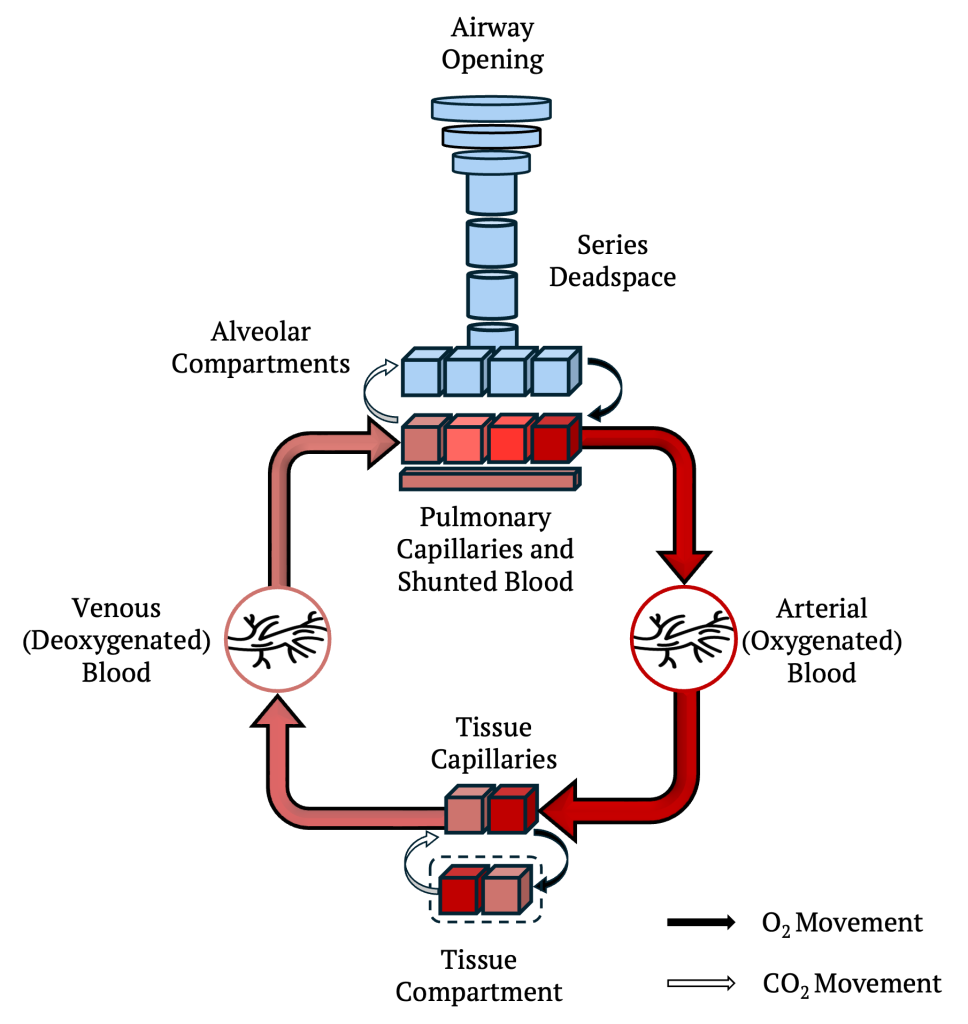
More recently, Dr Weaver’s team have also begun developing machine learning (ML) algorithms that predict how individual patients might respond to therapy, offering a route toward more personalised and adaptive respiratory support. The team have already been able to compare eight forms of respiratory support across 120 virtual patients. By applying treatments to identical patients at the same disease stage, they can isolate the effects of each intervention without confounding environmental factors, thus demonstrating one of the key benefits of in silico approaches: the ability to compare interventions under controlled, reproducible conditions.
Understanding In Silico Research
In biomedical research, in silico models are used to simulate biological systems across multiple levels of organisation, from individual cells to entire organs and organisms. These models then enable researchers to investigate disease mechanisms and predict how biological systems may respond to different conditions, interventions, or treatments.
A common misconception is that in silico research is synonymous with AI, which as Dr Weaver notes is not the case.
“Data driven modelling (of which AI is a form) is an important part of in-silico work and will likely continue to grow, but this is by no means the only form of in-silico approach.”
Dr Liam Weaver
In actual fact, in silico approaches broadly fall into two categories:
1. Mechanistic Approaches
Which rely on physical, mathematical, and physiological rules to model a biological system. For example, computational fluid dynamics can be used to simulate blood flow in cardiac systems.
2. Data-driven Approaches
Such as artificial intelligence (AI) and machine learning (ML), which rely on the input of actual experimental data to estimate how a system might behave in various scenarios. Increasingly, these approaches are integrated with large-scale multi-omics datasets, enabling the incorporation of complex biological information into in silico models and improving the prediction of disease mechanisms and therapeutic responses. For example, ML models trained on drug response data can predict how a new compound may affect liver toxicity without the need for laboratory testing.
Dr Weaver’s work focuses predominantly on developing and utilising mechanistic approaches.
The Advantages of In Silico Research
The rise of in silico research is largely attributable to its ability to process and analyse huge amounts of data at a scale and complexity far beyond human capability. Besides this, in silico methods offer insights that are challenging to replicate through conventional wet lab approaches. Models representing systems such as patients, organs, or even cells can be easily adjusted by modifying input parameters, allowing researchers to efficiently and rapidly simulate a wide range of conditions and pathologies. This is enabling researchers to gain insights that may have been impractical or impossible to uncover otherwise.
“Once the model has been developed, there is little to no penalty with respect to time or resource for running experiments to see what may happen, meaning that these models are a great testbed for early stage, curiosity driven, medical research.“
Dr Liam Weaver
Dr Weaver’s work serves as a prime example of how these approaches can be used to measure parameters that are inaccessible or would disrupt the system if assessed directly. By developing a mechanistic model of thecardiopulmonary system, the team were able to study the mechanical properties in different regions of the lung during ventilation, insights that are unattainable in vivo.
Designing and Running a Mechanistic Model
Dr Weaver’s work focuses on the development and utilisation of mechanistic models, for which researchers first need to build a virtual test system. These are typically based on established physiological, physical, and chemical principles. These experimental models are rarely built from scratch as scientists often optimise and build on existing frameworks, thus allowing faster and more efficient investigation of new questions. Many mechanistic models also need to rely on approximations when certain data is not available. However, Dr Weaver does not see use of estimates as a major limitation:
“No in-silico model can fully replicate the complexity of human physiology, but the aim isn’t to be perfect, it’s to be useful for a potential application.”
Dr Liam Weaver
Once the mechanistic model is built, it can be populated with either patient-specific data or physiological values from the literature to represent an “average” patient. With the model fully configured, researchers can then introduce changes or disturbances to the system and compute the resulting outcomes. For example, in case of Dr Weaver’s research on cardiopulmonary systems, changes to ventilator pressure can be introduced and the consequential changes to respiratory mechanics can be measured.
What Lies Ahead: Digital Twins and the Rise of Personalised Lung Medicine
In silico research is one of the fastest growing areas in biomedical science, offering the potential to make research more human-specific by using human data to develop both data-driven and mechanistic computational models. The long-term aim for many in silico researchers is to create more accurate, personalised representations of human biology that can improve disease understanding, guide treatment decisions, and advance development of personalised medicine, where clinical decisions are tailored to each patient.
“There is a clear movement towards human-specific approaches as opposed to animal models, and I believe that we are on the cusp of making this change a reality. I think that over the course of the next 10 years, the evidence will demonstrate to regulators the benefits of in-silico approaches and the role that they can play within the therapy development and validation landscape.”
Dr Liam Weaver
One area that is of particular interest to Dr Weaver is the concept of digital twins, which to many may sound like something from a science fiction film, but is actually gaining a lot of attention within clinical research.
At the most basic level, computational models can be developed using generalised physiological and clinical data from the literature to represent an average patient population. At the more advanced level, patient-specific models can be created based on data from a specific patient to represent unique physiology. At the most sophisticated level, a digital twin model can be developed using continuously updated real-time clinical data, creating a dynamic two-way interaction between the patient and the model. Dr Weaver describes how the use of such advanced digital twin models could look like in clinic:
“In practice, a digital twin would appear as a bedside decision support tool which would receive patient monitoring data (arterial blood gases, vital signs, ventilator settings) in real time as an input and could offer ‘simulate-before-treatment’ capabilities at the bedside, allowing clinicians to optimise treatment as a patient’s condition adapts and moving us towards truly personalised treatment for each patient in acute respiratory failure.”
Dr Liam Weaver
Encouragingly, the foundations for digital twins are already being established. One example is Dr Weaver’s patient-specific models of the lung and pulmonary circulation, which are designed to investigate why patients respond differently to the same treatment. By representing up to 100 individually configurable alveolar compartments, these models capture the complex heterogeneity of real lungs and allow scientists to assess mechanical stress, injury risk, and physiological responses in ways that are simply not possible in vivo.
Current Challenges in In Silico Research
Despite their potential, in silico approaches still face several challenges which are hindering widespread integration into biomedical research.
“The first issue relates to regulation, and the acceptance of in-silico evidence within the regulatory approval pathway for medical treatments and interventions. This would allow for in-silico modelling to be used in place of animal models to demonstrate a treatment’s ability to comply with specific regulatory stipulations and standards.“
Dr Liam Weaver
Although UK regulations do not explicitly require animal data, such evidence unfortunately remains the established standard, meaning in silico methods must gain greater regulatory confidence. This issue is especially pronounced in AI and ML models, often described as “black boxes” due to their lack of interpretability. This makes it difficult for regulators to verify data handling and ensure results are trustworthy and reproducible. To address this, organisations such as the InSilicoUK Network are working to advance the development, validation, and regulatory acceptance of computational methods. Through case studies and collaborations, the network is building evidence for the use of in silico modelling in treatment validation and exploring applications such as virtual clinical trials.
Another limitation of in silico methods is the lack of interconnected, system-level models. Existing approaches are often confined to single organs or simplified two-organ systems, meaning they capture local rather than systemic effects. There is a need for more advanced, integrated multi-organ models that better replicate systemic physiology.
Dr Weaver highlights another challenge, one shared by many emerging technologies: how the technology is perceived by the broader scientific community.
“The key issue with in-silico methodology is communication – we need to destigmatise the use of computational modelling within medical research and better promote the advantages of this approach.“
Dr Liam Weaver
As in silico research continues to advance rapidly, greater trust and clearer communication are needed to demonstrate how these methods can work together to replace animal models.
Maximising the Impact of In Silico Research
With more than five years of experience in the field, Dr Weaver has a deep understanding of how to maximise the impact of in silico research. He highlights two key factors for success: human expertise and effective integration with in vitro methods.
“The interpretation of model outputs requires clinical and physiological expertise, with the computational result only becoming meaningful when it is contextualised within the broader clinical picture by someone who understands both the model’s assumptions and the patient’s condition.“
Dr Liam Weaver
Despite rapid advances in in silico methods, these approaches are most powerful when integrated with other human-relevant technologies, such as organoids, organ-on-a-chip, and three-dimensional (3D) human cell culture. Dr Liam Weaver emphasises the importance of combining computational models with experimental systems to support the development of alternatives to animal studies:
“Computational models rely heavily on both data and an understanding of biological processes from which we can abstract mathematical relationships. Therefore, continued in-vitro work is critical for the continued success of in-silico research.“
Dr Liam Weaver
Such integrated approach aligns with the directions set out by both the FDA in the US and the UK government in their recent roadmaps for reducing reliance on animal studies. Rather than promoting a single replacement technology, these strategies highlight the value of combining complementary in vitro and in silico approaches to generate more predictive and human-relevant evidence for research and drug development.
Current integration however remains limited, hindered by problems with data quality, consistency, and availability. Improving data sharing, curation, and standardisation will be essential for development of reliable computational models and for maximising the predictive potential of laboratory-based experimental research. Meaningful progress will require collaboration across the scientific ecosystem, bringing together the two communities and other key stakeholders.
“Bringing together the in vitro and in silico communities will accelerate this change rapidly, and if buy-in from the regulatory bodies is achieved, in silico approaches could transform our ability to provide lifesaving therapies to our patients faster, and with greater precision, than ever before.“
Dr Liam Weaver
Final Thoughts
The increasing convergence of mechanistic modelling, AI, and human-specific data is positioning in silico research as an integral part of biomedical research and clinical decision-making. Digital twins represent the next step, enabling continuously updated, patient-specific models that can guide real-time care. Dr Liam Weaver’s own work in cardiopulmonary modelling already illustrates how personalised, physiologically grounded simulations can capture complexity and variability of real patients.
Beyond clinical applications, in silico approaches also have significant potential across basic and translational research, where they can be used to explore disease mechanisms, prioritise hypotheses, and support early-stage drug development. In these settings, computational models can help reduce reliance on animal studies by enabling researchers to simulate biological processes, predict experimental outcomes, and refine study design before moving into laboratory or in vivo work.
With growing interdisciplinary collaboration and accumulating clinical evidence, in silico methods are bound to transform how diseases are understood, treatments are developed, and patient care is delivered.