
Organ-on-chip
Organ-on-chip technologies are advanced microfluidic systems designed to replicate the in vivo functions, biomechanics, and (patho)physiological responses of organs or tissues. These devices are typically made from optically transparent plastic, glass, or flexible polymers, such as polydimethylsiloxane (PDMS) and consist of microchannels that house selected populations of living cells and culture media.
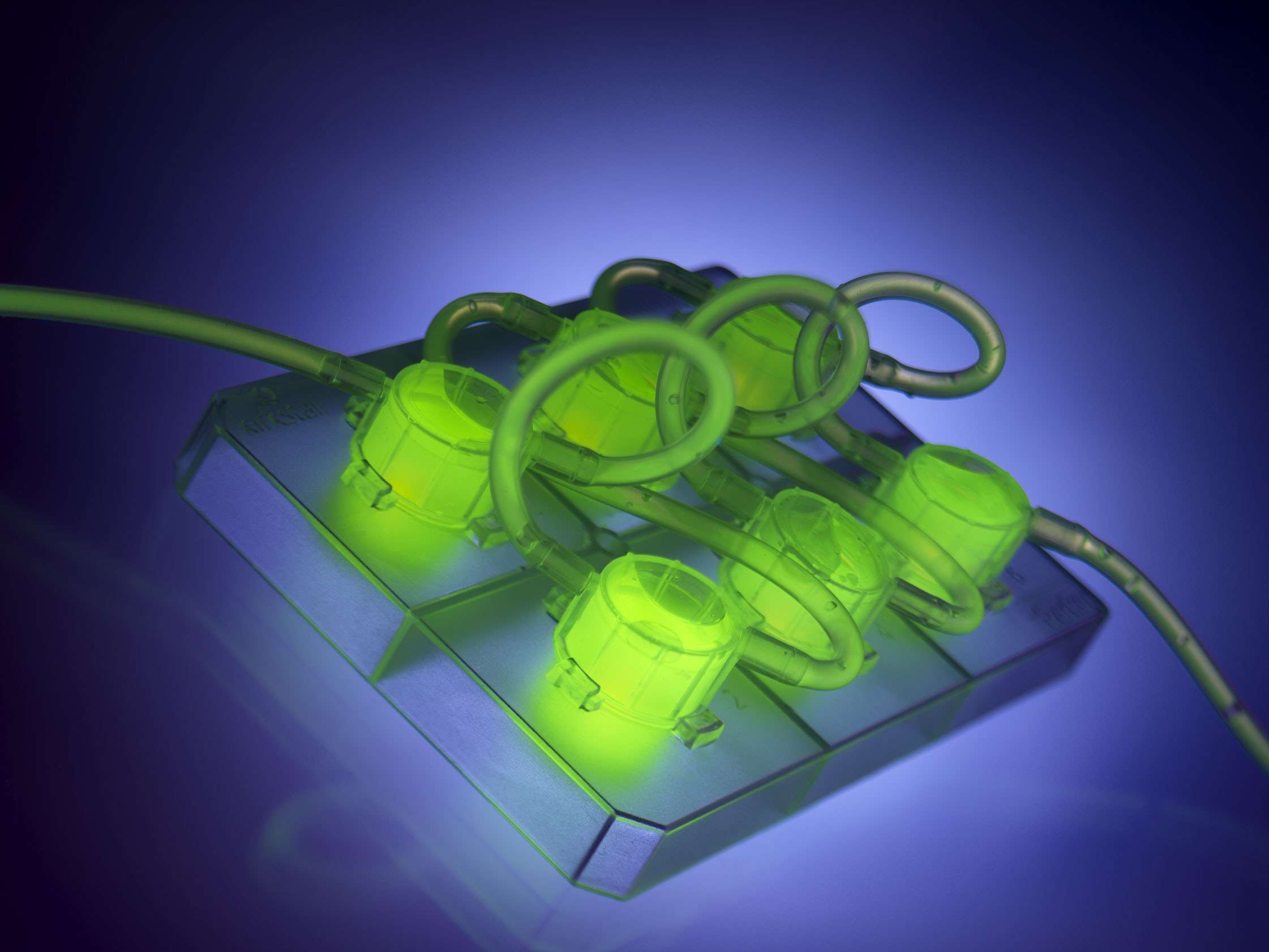
Courtesy of Kirkstall Ltd
Organ-on-chip Applications
- Drug discovery and development: Can be used to evaluate the efficacy and toxicity of new drugs, providing more accurate predictions of human responses than traditional methods.
- Disease modelling: Valuable for studying disease mechanisms and progression in areas including cancer, cardiovascular diseases, and neurodegenerative disorders.
- Personalised medicine: Enable the creation of patient-specific models for the testing of personalised treatment strategies and identification of the most effective therapies for individual patients.
- Toxicology testing and environmental monitoring: Can be employed to assess the safety of chemicals, cosmetics, and environmental toxins, providing essential data for regulatory safety testing.
Organ-on-chip Advantages
- Range of complexity: Can vary from simple designs with a single channel and one cell type to complex “organ chips” that integrate multiple cell types representing various tissues. This allows for the study of intercellular communication and interactions.
- Vascular mimicry: An endothelialised channel, representative of blood vessels, can be integrated to simulate in vivo complexity by perfusing it with suspended immune or cancer cells or even whole blood.
- Real-time monitoring: The automation of chip perfusion facilitates the monitoring of tissue function and dynamic responses in situ and in real time, enhancing experimental data collection.
- Controlled environments: Small channel dimensions enable highly controlled microenvironments where multiple biochemical and biomechanical cues, essential for cell signalling and behaviour, can be applied and controlled simultaneously.
- Long-term culture: Steady perfusion of culture medium at low flow rates allows for prolonged maintenance and observation of cells, extending the duration of experiments up to weeks or months.
- Tailored models: Can be customised to mimic specific patient conditions, aiding the development of personalised medicine and targeted treatments.
- Rare disease research: Provide a valuable platform for investigating rare diseases, particularly when tissue samples are limited.
Organ-on-chip Limitations
- Oversimplification of interactions: May not fully capture the complex interactions present in the human body, necessitating further validation to ensure that these models accurately predict clinical outcomes.
- Complexity and cost: Developing and maintaining organ-on-chip systems can be intricate and costly, requiring specialised equipment and expertise.
- PDMS limitations: PDMS, the most commonly used material for chip fabrication, can absorb small hydrophobic molecules non-specifically, including certain drugs, which may impact experimental results.
- Limited high-throughput capabilities: The complexity of organ-on-chip systems can make them less amenable to high-throughput screening methods.
- Limitations with micro scale channels: Flow of nutrient and supply of oxygen can be severely restricted because the resistance to flow increases according to the inverse 4th power of channel radius. Hence many micro scale organ-on-chip designs either have inadequate oxygen or nutrient supply to the cells or require unrealistically high pressures to drive media through the channels. Micro scale channels are also susceptible to bubbles and blockages.