


Drug discovery and development has become an increasingly costly and inefficient process. Despite the enormous resources funnelled into each drug candidate, a staggering number of them fail to ever reach the market. In this article, we provide an overview of the reality of drug discovery and development, exploring the key challenges that plague this process. We pay particular attention to the critical disconnect between early-stage development and clinical trials, and the fact that preclinical studies often fail to reliably predict clinical trial outcomes.
An Overview of the Drug Discovery and Development Process

Drug discovery and development is typically a multi-stage process (Figure 1). It begins with Discovery and Development, for which there are two widely recognised approaches: target-based drug discovery and phenotype-based drug discovery1. Target-based drug discovery focuses on a specific biological target – such as a protein, enzyme, or receptor that is involved in a disease. The goal is to develop a drug that interacts with this target to modify its activity, leading to a therapeutic effect. In contrast, phenotype-based drug discovery involves the screening of compounds to identify those that can elicit a desired effect on a disease phenotype, without initially knowing the biological target. Irrespective of the approach, promising compounds are further optimised for pharmacological properties such as potency, selectivity, and drug like-characteristics (e.g., solubility, stability, and bioavailability). The most promising progress to Preclinical Studies, where lead compounds are tested in vitro and in vivo to assess safety and efficacy. These studies are essential to ensure that a compound is not toxic before being given to humans. Successful candidates advance to Clinical Trials, which typically occur in three phases, starting with small safety studies (Phase I). This is followed by larger studies designed to assess efficacy in patients who have the condition for which the drug is being developed, while also providing additional safety data (Phase II). Finally, large-scale studies (Phase III) further assess safety, dosage, and efficacy across a diverse population and in various settings. If these trials succeed, the drug enters the Review and Approval stage, where regulatory bodies assess the data before the drug is approved for market use. After approval, the drug continues to undergo ongoing post-market surveillance to increase pharmacovigilance.
It is worth highlighting that the typical drug discovery and development process presented is not a one-size-fits-all approach. The development of the COVID-19 vaccines provides a clear example of how the process can be adapted to expedite the approval of new therapies. In contrast to the usual linear sequence, where preclinical testing precedes clinical trials, in 2020, regulators allowed a COVID-19 vaccine to be tested in humans at the same time as animal tests were carried out2. Furthermore, in response to the urgent need for a vaccine, regulators implemented a rolling review process, in which data were submitted and evaluated as they became available. Traditionally, clinical trial data packages are assessed only upon completion of each phase. These shifts in regulatory strategy and a divergence from the standard drug discovery and development process significantly contributed to reducing vaccine development timelines during the pandemic to roughly one year3.
An assessment of first-in-class oncology drugs over the last decade (2010-2020) gives an interesting insight into some of the key players throughout drug discovery and development (Figure 2). In this example, a significant proportion of drugs were found to originate from small and medium pharma companies (including biotechs), and to a lesser extent large pharma and academia4. In contrast, at the time of launch, it was large pharma that owned or co-owned the majority of drugs (Figure 2). This was achieved mainly through licencing and acquisitions4. There is also a huge role to be played by contract research organisations (CRO) which are setup to offer specific services to support early discovery through to clinical trials. It has been estimated that nearly three out of every four clinical trials are conducted by a CRO5. It is in the best interests of all parties that the drug discovery and development process be streamlined and efficient, maximising success while minimising cost and time.

The Reality of Drug Discovery & Development
Drug discovery and development is becoming slower and more expensive over time, despite advancements in technology and scientific knowledge.
Eroom’s law
Pharmaceutical research and development (R&D) efficacy is declining. Since 1950 the number of new drugs approved per billion US dollars spent on R&D (inflation adjusted) has halved roughly every 9 years – a observation referred to as Eroom’s law6. The pharmaceutical industry continues to invest vast amounts of money into the drug development process. In 2023, the top 20 biopharma companies collectively poured $145.5 billion into R&D, reflecting a 4.5% increase from the previous year7. Despite increasing R&D spending, the return on investment for these companies remains disappointingly low, hovering at just 4.1% in 2023. If successful, a drug entering the market has the potential to be extremely lucrative, but there currently exists a disconnect between financial input and output.
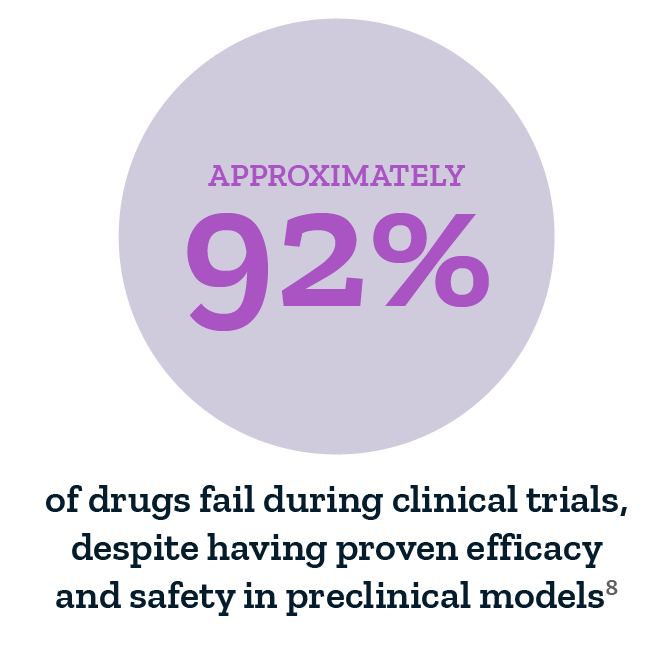
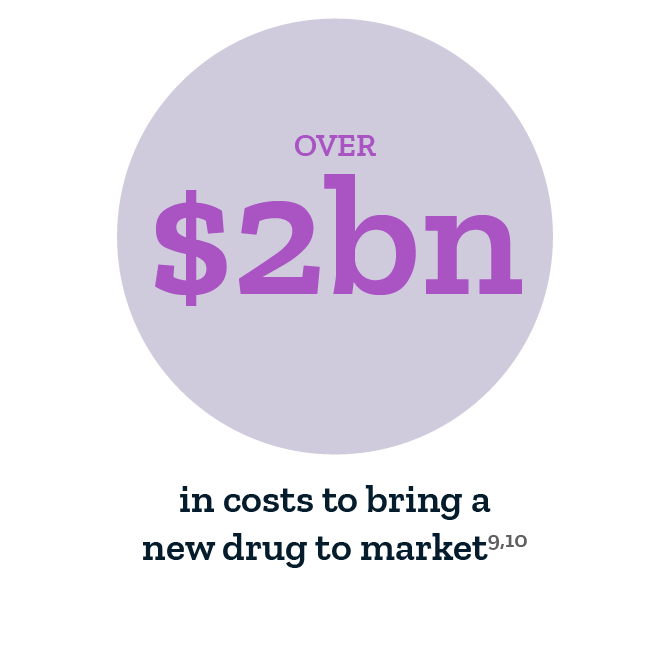
While the cause of this disconnect between investment and output is undoubtedly multifactorial, it is certainly compounded by the fact that around 92% of drugs fail during clinical trial, despite having proven efficacy and safety in preclinical models8,9. This number varies depending on multiple factors such as disease area, prevalence, and drug modality. Drugs targeting neurology, oncology, cardiovascular disease, and urology have some of the lowest likelihoods of approval (Figure 3)9. With such a high failure rate it is perhaps unsurprising that bringing a single drug to market is reported to cost over $2 billion when accounting for the cost of failures10,11. It has been reported that around a third of the total costs are incurred during the discovery and development, and preclinical study phases, before a drug even reaches clinical trials10. That means a considerable portion of money is being invested in drugs that are never likely to make it to market.

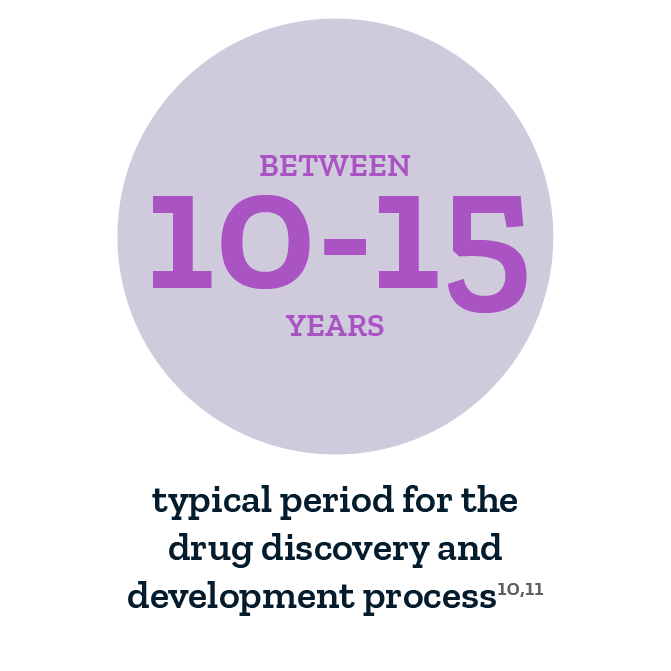
Drug development also requires a huge time investment, with the development of a drug from initial discovery to market approval often taking between 10 to 15 years (Figure 1)11,12. This timeline can be further divided into the different stages of drug development: Discovery and Development typically takes around 4.5 years; Preclinical Studies take approximately 1 year; Clinical Trials can extend over 6.5 years; and the Review and Approval process adds another 1.5 years12. Of course, exact timeframes can vary significantly based on factors such as the class of drug and the disease it aims to treat. However, this lengthy development process has profound implications. Put simply, more time equates to more money spent. Every additional year in development racks up costs, compounding the already massive investment required for drug development. Extended development times also impact the commercial viability of a new drug through the effect on patent life. Patents, which generally last a maximum of 20 years, are crucial for protecting a drug from competition and allowing the innovating company to recoup its investment. The longer the drug development process takes, the shorter the period of market exclusivity before the patent expires. This compressed window of profitability can severely limit the return on investment, as competitors – once able to enter the market – drive down prices13.
Considering the huge investment in time and money, it is unsurprising that important questions are being raised about the efficacy of our current drug development paradigm. This has sparked a concerted effort to understand the underlying reasons for the disconnect between preclinical and clinical research, and to explore alternative methods which could serve to better predict how a drug will perform in clinical trials.
The Disconnect Between Preclinical and Clinical Studies
The reality of drug development is that success in preclinical testing offers no guarantees in clinical trials. Although the rate of successful phase completion varies depending on the source data, it remains clear that transitioning one phase to another is often no more certain than a coin toss9,14–16. Between 2011 and 2020, clinical development success rates were reported to be 52% for Phase I, 29% for Phase II, and 58% for Phase III9. The primary reasons for failure? Lack of efficacy and unexpected toxicity (Figure 4). Just under half of the drugs that fail in Phase II do so because of lack of efficacy. Safety concerns account for approximately a quarter of failures, with operational, strategic, and commercial issues making up the rest17,18. Assessment of Phase III in isolation paints a similar picture, with over half of failures attributed to lack of efficacy (Figure 4)19.

Early drug discovery and preclinical testing has always relied heavily on the use of animal experiments. In 2008, drug development accounted for the second highest animal use (~23%) in the European Union and was second only to fundamental biology studies (~38%). Preclinical toxicology testing accounted for around 9%19. By and large these figures are consistent with the 2023 UK findings which show that 25% of experimental procedures carried out on animals were done so for translational research / drug development. Again, this was second to basic research which accounted for the highest animal use (52%). Regulatory testing, which encompassed safety and efficacy evaluation accounted for 21%20. Given the poor clinical trial success rates and the heavy reliance on animal studies in early drug discovery and preclinical testing, many question – how reliable is animal research in drug development?

Animal Use in Drug Discovery and Development
Animal research has long been intertwined with the drug discovery and development process, which routinely relies on a variety of species, particularly mice and rats, for early-stage drug discovery through to preclinical studies22. Animals are typically used with increasing numbers in the late drug discovery phase when a lead is being optimised, during candidate selection for pharmacokinetic/pharmacodynamic (PK/PD) and efficacy, and in regulatory required safety studies23. The requirement for animal toxicity testing dates back to 1937 when over 100 people died after taking a liquid antibiotic formulation that contained ethylene glycol, a toxic substance. In response, animal toxicity testing became a legal requirement, and for many years animal research was seen as the gold standard for ensuring drug safety. In the last few years this stance has started to change as there is a growing body of evidence questioning the value and relevance of animal research given the extremely high drug failure rates during clinical trials.
Before considering this relevance, it is first worth discussing the cost of animal research. While it is difficult to find exact details on the impact of animal research on drug development costs, it is safe to assume that it is considerable. As stated before, it has been reported that over a third of drug development costs are spent before clinical trials; the part which typically relies heavily on the use of animals10. Estimated costs for toxicology testing and safety evaluation in Europe give further insight into the high cost of animal research. A short-term repeated dose test costs €49,390. A carcinogenicity test costs €780,35724. In toxicity testing, animal tests are 1.5x to more than 30x as expensive as in vitro testing25.
Looking to assess the translation of animal research findings to human benefit, a 2006 review of 76 animal studies found that only about 37% of highly cited animal research was ever replicated in humans. Even more striking, approximately 18% of these studies were later contradicted by human data26. Another study that reviewed six interventions – ones that had clear effects, whether positive or harmful, in clinical trials – showed that only half had outcomes consistent with the animal experiments27. These findings highlight an important issue: in many cases efficacy in animal models does not translate to efficacy in humans.
Focusing on toxicology, there are two outcomes that need to be avoided in preclinical testing: (1) a toxic drug being misidentified as safe and (2) a safe drug being misidentified as toxic. If a safe drug is falsely recognised as toxic, it is almost always discarded, and any potential benefits it could offer to human health are lost. Although it is difficult to quantify how many drugs have been abandoned because of this, we can look to historical examples for insight. Aspirin, a widely used drug, would likely never have made it to market if it had been subjected to today’s rigorous animal testing standards. In today’s world, this drug that has improved countless lives, would face immense hurdles to gain approval28.
If a drug is falsely recognised as safe, it can move to clinical trials, where the consequences of undetected toxicity can be severe. There are many specific examples of cases in which animal studies have failed to predict severe human toxicity, and these have been well summarised elsewhere13,29.
Numerous studies have aimed to accurately assess how relevant preclinical animal models are in predicting human toxicity, but interpretation can be challenging due to the different methodologies and terms used across different studies, making it difficult to draw a general conclusion30–36. For many, likelihood ratios (LR) are considered the most direct and transparent method of quantifying the evidential weight of preclinical animal studies37. In this setting, a positive LR indicates how much preclinical animal data can strengthen the belief that a specific drug is toxic in humans. A negative LR indicates how much preclinical animal data can strengthen the belief that a specific drug is not toxic in humans34. Using this method, researchers have found that whilst positive toxicity results in animal studies (across species like mice, rats, dogs, and monkeys) add some variable weight to the risk of toxicity in humans, negative toxicity tests in animals provide little to no weight that toxicity will also be absent in humans32–36. In other words, a drug that doesn’t cause toxicity in animals won’t necessarily be safe for humans.
Conclusions
As outlined in this article, there is a growing body of evidence to suggest that preclinical studies often fail to predict human outcomes accurately. This has significant implications for the industry. Whilst the goals of ensuring that only safe and effective drugs proceed to clinical trials is shared by all, we must question whether our current methods are truly the most reliable. In recent years, advances in human-focused technologies such as organ-on-chip and in silico analysis, coupled with shifts in regulatory requirements such as the FDA Modernisation Act 2.0 have opened the door to more human-specific research in early drug discovery and development. With these innovations, it’s no surprise that many are rethinking the role of animal testing in their drug development process.
Do you agree with our insights? If you have an alternative view point we’d love to hear from you here.
About the Author

Dr Ross Dobie
Head of Science
As Head of Science at the Centre for Human Specific Research, with over 10 years of academic and industry experience, Ross oversees service delivery and content for the Centre.
You may also be interested in:
Explore our online resource to learn more about different human-focused technologies and their applications, and gain insights into their advantages and limitations.

Hurdles Preventing the Adoption of Human-Specific Research
We address some of the hurdles preventing the adoption of human-specific research and discuss the current state of play.
References
- Singh, V. K. & Seed, T. M. How necessary are animal models for modern drug discovery? Expert Opin. Drug Discov. 16, 1391–1397 (2021).
- Boodman, E. Researchers rush to test coronavirus vaccine in people without knowing how well it works in animals. (2020). Available at: https://www.statnews.com/2020/03/11/researchers-rush-to-start-moderna-coronavirus-vaccine-trial-without-usual-animal-testing (Accessed: 29 November 2024).
- Agrawal, G. et al. Fast-forward: Will the speed of COVID-19 vaccine development reset industry norms? (2021). Available at: https://www.mckinsey.com/industries/life-sciences/our-insights/fast-forward-will-the-speed-of-covid-19-vaccine-development-reset-industry-norms (Accessed: 29 November 2024).
- Kennedy, K. H. et al. Small biotechs versus large pharma: Who drives first-in-class innovation in oncology? Drug Discov. Today 28, 103456 (2023).
- Business Wire, Research and Markets: The new 2015 trends of global clinical development outsourcing market. (2015). Available at: https://www.businesswire.com/news/home/20150130005621/en/Research-and-Markets-The-New-2015-Trends-of-Global-Clinical-Development-Outsourcing-Market (Accessed: 29 November 2024).
- Scannell, J. W. et al. Diagnosing the decline in pharmaceutical R&D efficiency. Nat. Rev. Drug Discov. 11, 191–200 (2012).
- Deloitte. Unleash AI’s potential – Measuring the return from pharmaceutical Innovation – 14th Edition. (2023). Available at: https://www.deloitte.com/uk/en/Industries/life-sciences-health-care/research/measuring-return-from-pharmaceutical-innovation.html (Accessed: 29 November 2024).
- Mullard, A. Parsing clinical success rates. Nat. Rev. Drug Discov. 15, 447–447 (2016).
- BIO, Pharma Intelligence, QLS Advisors. Clinical development success rates and contributing factors 2011-2020. (2021).
- DiMasi, J. A. et al. Innovation in the pharmaceutical industry: New estimates of R&D costs. J. Health Econ. 47, 20–33 (2016).
- Lim, S. The process and costs of drug development (2022). Available at: https://ftloscience.com/process-costs-drug-development (Accessed: 29 November 2024).
- Sun, D. et al. Why 90% of clinical drug development fails and how to improve it? Acta Pharm. Sin. B 12, 3049–3062 (2022).
- Hartung, T. The (misleading) role of animal models in drug development. Front. Drug Discov. 4 (2024).
- BIO, Biomedtracker, Amplion. Clinical development success rates 2006-2015. (2016).
- Hay, M. et al. Clinical development success rates for investigational drugs. Nat. Biotechnol. 32, 40–51 (2014).
- Wong, C. H. et al. Estimation of clinical trial success rates and related parameters. Biostat. Oxf. Engl. 20, 273–286 (2019).
- Arrowsmith, J. & Miller, P. Phase II and phase III attrition rates 2011–2012. Nat. Rev. Drug Discov. 12, 569–569 (2013).
- Harrison, R. K. Phase II and phase III failures: 2013–2015. Nat. Rev. Drug Discov. 15, 817–818 (2016).
- Hwang, T. J. et al. Failure of investigational drugs in late-stage clinical development and publication of trial results. JAMA Intern. Med. 176, 1826–1833 (2016).
- European Commission. Sixth report on the statistics on the number of animals used for experimental and other scientific purposes in the member states of the European Union. (2010).
- UK Government. Annual statistics of scientific procedures on living animals, Great Britain: 2023. (2024). Available at: https://www.gov.uk/government/statistics/statistics-of-scientific-procedures-on-living-animals-great-britain-2023/annual-statistics-of-scientific-procedures-on-living-animals-great-britain-2023 (Accessed: 29 November 2024).
- Hickman, D. L. et al. Commonly used animal models. Princ. Anim. Res. Grad. Undergrad. Stud. 117–175 (2017).
- Ekert, J. E. et al. Recommended guidelines for developing, qualifying, and implementing complex in vitro models (CIVMs) for drug discovery. SLAS Discov. 25, 1174–1190 (2020).
- Bottini, A. A. & Hartung, T. Food for thought … on the economics of animal testing. ALTEX – Altern. Anim. Exp. 26, 3–16 (2009).
- Norman, G. A. V. Limitations of animal studies for predicting toxicity in clinical trials: Is it time to rethink our current approach? JACC Basic Transl. Sci. 4, 845 (2019).
- Hackam, D. G. & Redelmeier, D. A. Translation of research evidence from animals to humans. JAMA 296, 1731–1732 (2006).
- Perel, P. et al. Comparison of treatment effects between animal experiments and clinical trials: systematic review. BMJ 334, 197 (2007).
- Hartung, T. Per aspirin ad astra. Altern. Lab. Anim. ATLA 37 Suppl 2, 45–47 (2009).
- Van Norman, G. A. Limitations of animal studies for predicting toxicity in clinical trials. JACC Basic Transl. Sci. 4, 845–854 (2019).
- Olson, H. et al. Concordance of the toxicity of pharmaceuticals in humans and in animals. Regul. Toxicol. Pharmacol. 32, 56–67 (2000).
- Meer, P. et al. The ability of animal studies to detect serious post marketing adverse events is limited. Regul. Toxicol. Pharmacol. RTP 64, (2012).
- Paglialunga, S. et al. Translatability of the S7A core battery respiratory safety pharmacology studies: Preclinical respiratory and related clinical adverse events. J. Pharmacol. Toxicol. Methods 99, 106596 (2019).
- Monticello, T. M. et al. Current nonclinical testing paradigm enables safe entry to First-In-Human clinical trials: The IQ consortium nonclinical to clinical translational database. Toxicol. Appl. Pharmacol. 334, 100–109 (2017).
- Bailey, J. et al. An analysis of the use of animal models in predicting human toxicology and drug safety. Altern. Lab. Anim. ATLA 42, 181–199 (2014).
- Bailey, J. et al. Predicting human drug toxicity and safety via animal tests: can any one species predict drug toxicity in any other, and do monkeys help? Altern. Lab. Anim. ATLA 43, 393–403 (2015).
- Bailey, J. et al. An analysis of the use of dogs in predicting human toxicology and drug safety. Altern. Lab. Anim. 41, 335–350 (2013).
- Matthews, R. A. Medical progress depends on animal models – doesn’t it? J. R. Soc. Med. 101, 95–98 (2008).